State v. David Wayne Hearing · Hancock County, Tennessee
Standing together for justice in the David Hearing case
Welcome to the central hub for updates, legal resources, and community solidarity surrounding the David Hearing case. Discover how we advocate for fairness and support transparency every step of the way.
Every person is owed a fair process, from the first warrant to the last appeal.
Transparency.
Every document in the open, so you can read the record for yourself.
Accountability.
Those who build a case must stand behind every page of it.
Twenty-three years. One question. The truth doesn’t expire.
A murder case built on one store receipt. A man who says the State knew it was wrong, and who has never stopped saying so.
David Hearing was arrested in August 2003 for killings he says he did not commit. He pleaded guilty in 2005, and he has spent the years since fighting it in court, arguing that the plea rested on evidence that could not hold. This is his record, page by page.
—days since his arrest
23YRSof litigation
3handwritten lines behind his warrant
Counting, second by second
Total time since David’s arrest
Every tick below is time he has spent fighting to clear his name.
Days
:
Hours
:
Minutes
:
Seconds
Since August 9, 2003
Who is behind this site
Let us first clarify exactly who is and is not behind this site. This site is the result of a joint effort between the friends, acquaintances and loved ones of Mr. David Wayne Hearing on the outside to help prove his innocence and end the injustice that has defined Mr. Hearing’s life for over two decades.
This site presents Mr. Hearing’s accurate and truthful account alongside public court records. Statements about how public officials and others acted are his allegations, which are well documented and, in some instances, are actual findings of a court. Apart from the two people who died, private individuals are not named.
With respect
Ance and Rebecca Pratt died in May 2001. Their families have waited a long time for the truth, too. Nothing here is meant to diminish that loss. This site exists because David Hearing and his supporters know beyond the shadow of a doubt that the truth is not what the State has said it is, and because the record he has built proves it.
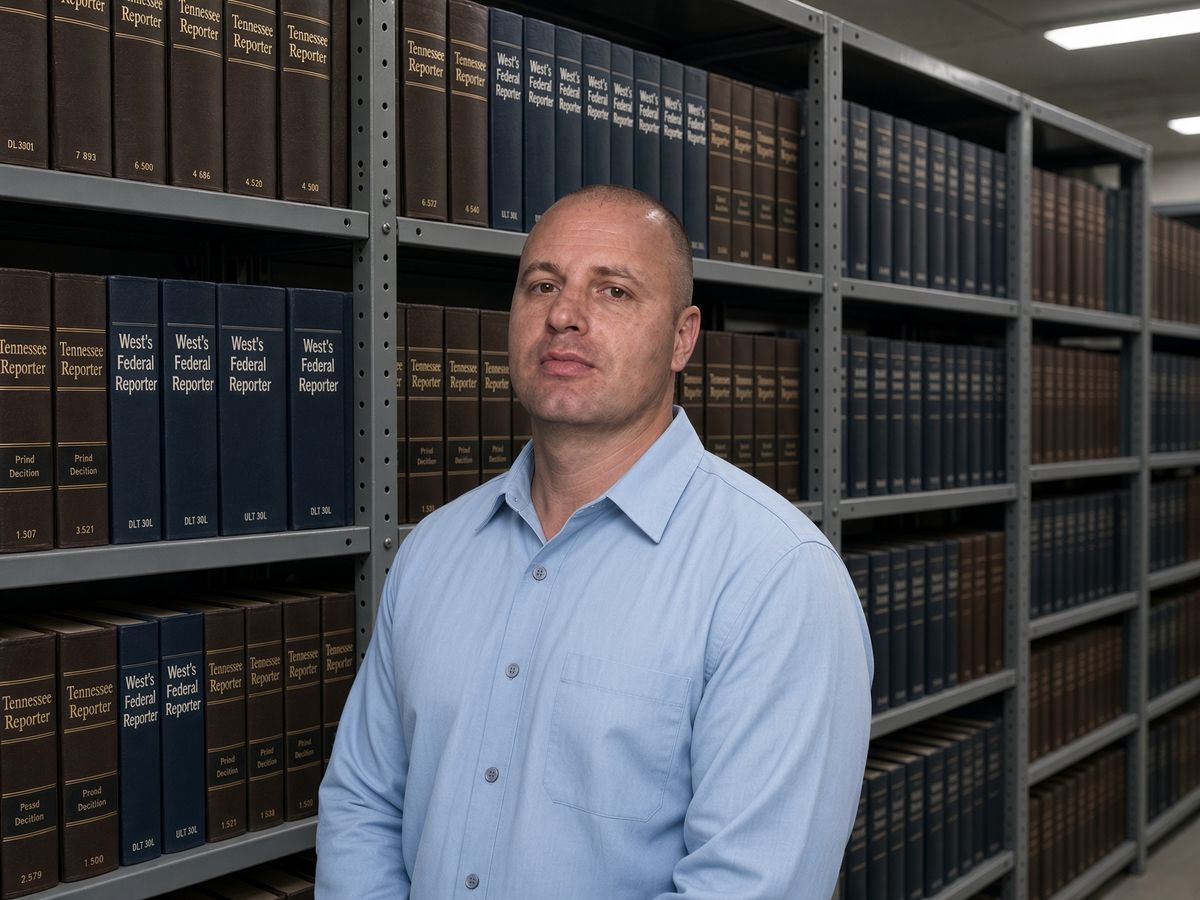
Digitized photo of David
Meet David
The word behind him is the whole story.
Behind the exhibits and the docket numbers is a person.
He says he learned his work ethic from his mother and four sisters. He says he walked away rather than let his six-year-old daughter be used as a bargaining chip. And he has maintained his innocence since the day he was arrested.
He did not wait to be rescued. By his own list, he has worked on 35 other people’s cases in seven states.
The sworn statement of probable cause on the arrest warrant. Personal identifiers blacked out.
He says the warrant had no probable cause behind it. A Tennessee court, he reports, agreed and dismissed it. The State then issued two new ones to keep him in custody.
How it started
It began in a divorce court.
On August 5, 2003, David Hearing walked into a courthouse expecting to finish a divorce. Within days he was under arrest for double murder.
By his account, everything had been worked out. His six-year-old daughter would stay with him. Property would be split. Then, he says, his wife and her attorney met him at the courthouse and made a demand: give up custody and pay more, or they would call the IRS about his marijuana income.
He refused to let his daughter become a bargaining chip. He asked the judge for a drug test of both parents. The court ordered it. He says he passed. His wife did not.
The same day, he says, her attorney called a federal prosecutor. A letter followed. Four days later he was arrested in the driveway of his sister's home in Texas, on his way to take her and her husband out for their anniversary.
“Me being young and prideful instead of asking for help, I chose to venture down paths to make it on my own.”David Hearing, on the marijuana business he ran
He does not claim to have been a model citizen. He describes selling and hauling large quantities of marijuana, including to Ance Pratt, one of the two people he is accused of killing. He says that history is what made him easy to accuse, and that the accusation arrived the moment his wife needed leverage.
The account above is Mr. Hearing’s, from his Statement of the Facts. The letter and the drug-test order are in the record.
The record
Two decades of not giving up.
Dates come from the court record and from his own Statement of the Facts. Tap an exhibit to read the page itself.
Aug. 5, 2003
A drug test, then a phone call
The divorce hearing. His account: he passed the court-ordered drug test, his wife failed, and her attorney contacted a federal prosecutor the same day.
Aug. 9, 2003
Arrested on a three-line affidavit
Taken into custody in Texas on a warrant for two counts of first-degree murder. The whole sworn basis for it fits in three handwritten lines.
Aug. 2003 – May 2004
Months fighting extradition
He challenged being sent to Tennessee. By his account he was not transferred until May 7, 2004.
Source: his Statement of the Facts, citing a Gregg County jail report
May 2004
The warrant is dismissed. Two new ones appear.
He filed a writ of habeas corpus on May 10 challenging the warrant. He says it was granted, and that the proof is what happened next: on May 20 the State served two fresh warrants, before any indictment. He was arraigned without a lawyer, he says, in a school classroom in Sneedville.
Source: his Statement of the Facts; May 20, 2004 warrants
June 2, 2004
The preliminary hearing
A state investigator testifies that the case began when the DEA in Texas called the TBI. The State also puts his then-wife on the stand about the August 5 letter. He says both sides treated that letter as a non-prosecution deal; he says it was never anything more than a proffer.
July 12, 2004
A trial date, before an indictment
The court order sets trial for Monday, December 6, 2004. He says he was not allowed to attend that conference, and that the grand jury had not yet returned its indictment.
April 2005
“Already knew”
In a filing, the State says that by the time his wife gave her written statement, Tennessee officers “already knew” a David Hearing had been moving marijuana. Separately, a ruling denies his motion for a bill of particulars because full discovery has been given.
Sept. 2, 2005
The guilty plea
He pleads guilty. The State would later cite that day as the moment he gave up the right to challenge the evidence. His argument: the factual basis for the plea included a receipt the State knew was wrong.
Source: State’s 2012 filing; his Statement of the Facts
Nov. 28, 2012
The State doubles down on the receipt
Answering his petition, the State writes that he had been given a copy of the store receipt before he pleaded, and that nothing in it was newly discovered.
Feb. 26, 2013
“I think so.”
In the transcript, the lawyer calling the investigator puts it to the judge that “this timeline” would be exculpatory of first-degree murder. The judge answers: “I think so.” Mr. Hearing says this is the day the State admitted the receipt was wrong and that it had hidden the witness who knew it.
2018 – 2019
The fight moves to federal court
A federal case opens in 2018. Most of the pages on this site were filed there, in Case No. 2:18-cv-00094.
Source: filing stamps on the pages
April 12, 2019
He writes a law-review-style article
On how Miller v. Alabama and Montgomery v. Louisiana apply to Tennessee juveniles serving life sentences, after the state supreme court clarified what a life sentence means.
Source: his own list of accomplishments
2019
A letter to the governor
He applies to Governor Bill Lee for commutation. His narrative ends where he began: he says he is innocent of these killings and has maintained it since the beginning.
Source: his commutation application and narrative summary
The argument
Three questions the record raises.
Not opinion. Two documents, side by side.
1
Who found whom?
The State’s 2005 filing says officers “already knew” of David Hearing before August 5, 2003.
The investigator’s own sworn testimony in 2004: the case reached him when the DEA in Texas called. Then they interviewed his wife. Then they got warrants.
He adds that the State once explained away the gap by saying an agent had misspelled his name as “Herring.”
2
A trial date with no indictment
A conference held July 12, 2004 produced an order setting his trial for December 6, 2004.
His position: the grand jury returned its indictment only that afternoon, and he was not allowed to attend the conference where the date was set.
3
One receipt, six uses
A cash-register receipt from Cox & Wright Food Market, dated 05/24/01 at 7:12 p.m., was listed as a trial exhibit. By his count it carried the arrest warrant, the preliminary hearing, the grand jury, the denial of a bill of particulars, the trial exhibit list, and the factual basis for his plea.
Then, in February 2013, he says the State conceded it was wrong, and that it had hidden the witness who knew.
These are Mr. Hearing’s readings of the record. They are allegations and arguments, not findings of any court, and the State has disputed them.
The man
Hope, in action.
From inside, David Hearing turned to the law, and then to other people’s cases.
By his own list, he left a trail of cases that moved: hearings granted, warrants lifted, families put back together on paper. He also wrote a law-review-style article on how the Supreme Court’s juvenile-sentencing decisions apply in Tennessee.
35matters he worked, by his own list
7states, from California to Georgia
10warrants and detainers lifted
5+evidentiary hearings secured
He helped a father fight to keep his parental rights.
He helped a father secure a court-appointed lawyer in a custody fight over his daughter.
He worked out a sentence calculation that, by his account, moved a release date up three years.
He helped men set up $5-a-month payment plans instead of losing half of every deposit to their trust-fund accounts.
Figures come from Mr. Hearing’s own list, “Success While Incarcerated,” dated Nov. 20, 2019. Names of the people he helped are not shown.
Read it yourself
The exhibits.
Ten pages from the record. Tap any page to read it.
Names of private individuals, addresses, phone numbers, ID numbers, birth dates and similar details have been blacked out of these copies. Yellow highlighting is original to the court filings.
What you can do
Be part of the answer.
Hope spreads one person at a time.
Read.
Open any exhibit above and read the page for yourself. It takes two minutes.
Share.
Send this page to one person who believes the truth matters.
Ask.
Ask why a case this old still rests on a single receipt.
In his own words
Hear it from David.
His Statement of the Facts promises a “short version,” then admits the case has more twists than a crime novel.
David has also written a book. It is the story told by the one person who has never stopped telling it.
The portraits on this page are digitized duplicates of actual images that come from real photos taken of Mr. Hearing throughout his decades-long prison sentence. In some instances, background imagery, as well as defects in the old photos themselves, was treated or corrected with AI image tools.
Know the man
See the evolution of a man fighting injustice.
Three portraits. One refusal to give up.
Digitized photo of David
01
The student
He learned the law.
From inside, David Hearing turned to the law, and then to other people’s cases.
He did not wait to be rescued. By his own list, he worked on 35 matters in seven states: evidentiary hearings secured, warrants and detainers lifted, a father helped to keep his parental rights.
In April 2019 he wrote an article on how Miller v. Alabama and Montgomery v. Louisiana apply to Tennessee juveniles serving life sentences.
35matters, by his own list
7states
10warrants and detainers lifted
5+evidentiary hearings secured
Figures: Mr. Hearing’s own list, “Success While Incarcerated,” Nov. 20, 2019
Digitized photo of David
02
The discipline
He kept his strength.
A fight like this outlasts moods, headlines and whole seasons of hope.
It rewards the people who keep showing up: the one more filing, the one more morning, the one more repetition. In a long fight, strength is mostly stubbornness with a plan.
Novelty bobblehead portrait
03
The spirit
Hope has a sense of humor.
The man in the file is more than the file.
Behind the dockets and the exhibits is a father who can still smile. Here he is as a novelty bobblehead, made for fun, a reminder that the people we argue about are people first.
The same man, every chapter
More than the file.
Through all of it, he says, he has maintained his innocence “since the beginning.” Read the record and decide for yourself.